


Wooden Crates. Foam Inserts. Corrugated Liners. One Job. Does Your ERP Actually Cost All of It?
Your ERP Tracks Numbers. But Does It Understand Wood, Foam, Corrugated Board and the Cost of Getting It, Wrong?
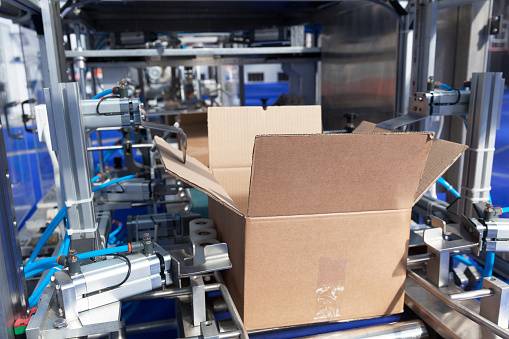
Composite packaging is not a simple business. You are not manufacturing one material into one product. You are combining wood, corrugated board, foam, plywood, polystyrene, plastics, and sometimes aluminium, all in a single order to create a pack that must survive road freight, air cargo, or export handling without failing.
Every order is different. Every pack has a unique design. Every raw material combination changes the cost. And every customer wants a quotation before you have even created the product in your system.
This is where generic ERP built for standard manufacturing, quietly breaks down.
Let us walk through exactly what composite packaging ERP software built for this industry looks like in practice and what it fixes that generic ERP never could.
- The Quotation Problem No One Talks About
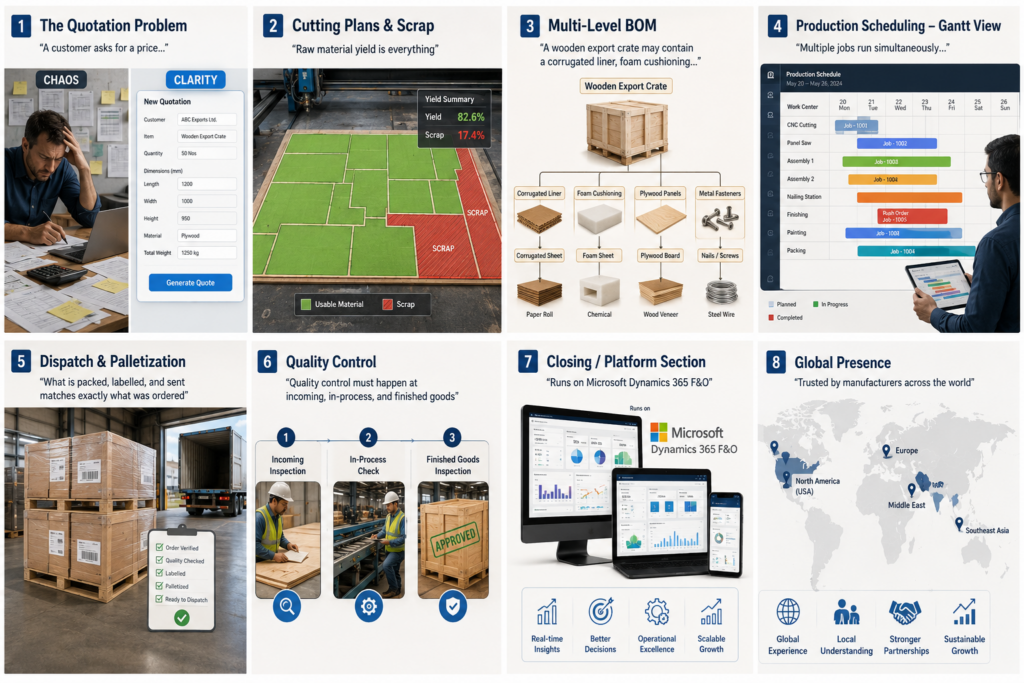
Most composite packaging businesses face the same painful moment: a customer asks for a price. Your team needs to cost a multi-level bill of materials for a product that does not yet exist in the system. The choices are to either guess, or spend two days manually building a product structure just to generate a number that may never convert to an order.
- Generic ERP was not designed for this. It assumes the product exists before costing begins.
Samadhan’s Composite Packaging ERP solves this at the root with its Presales Costing Product Design Interface (PSPDI), a feature built specifically for composite and wooden packaging manufacturers. Your team can define attributes like length, width, and height, cost multi-level BOM structures accurately, include resource costs, tooling, development, and freight; all without creating a single item in the system.
Only when the quote is approved does the system, with one click, automatically create all items, finished goods BOMs, and production routes. No duplication. No manual entry. No rework.
This is not a workaround. This is how composite packaging businesses should be operating.
- Cutting Plans and Scrap: The Hidden Margin Killer
In composite packaging, raw material yield is everything. Whether you are cutting foam sheets, sizing plywood panels, or processing corrugated mother rolls, the difference between estimated and actual scrap directly determines whether a job is profitable.
- Generic ERP records scrap. It does not manage it.
Samadhan’s solution builds cutting plan optimisation directly into the production flow. Before cutting begins, the system generates a yield plan that estimates leftover material, identifies expected scrap quantities, and assigns a cost to each. When actual cutting takes place, the system tracks real scrap against the estimate, giving management a variance they can act on, not just report on.
Critically, the system also allows raw material substitution at the cutting planning stage. If a mother raw material item needs to change due to availability or price, the planner can adjust it and immediately see the cost impact. This flexibility is rare in standard ERP systems and essential in composite packaging, where material availability shifts constantly.
- The Multi-Level BOM Challenge
Composite packaging assemblies are rarely single-level. A wooden export crate may contain a corrugated liner, foam cushioning, plywood panels, and metal fasteners each of which may itself have sub-components. Costing this accurately at the quotation stage, tracking it through production, and reconciling it in finance requires a system that genuinely understands multi-level bill of material structures.
Samadhan’s ERP handles complex multi-level BOMs natively — not through workarounds or manual adjustments. The Preproduction Product Design Interface (PPPDI) associates BOM and route details with finished goods in two clicks, ensuring that what was costed in the quotation reflects exactly what is produced on the shop floor and what appears in the financial accounts.
Estimated versus actual cost comparison is live, not a month-end exercise.
- Production Visibility: From Gantt to Dispatch
Composite packaging production is not linear. Multiple jobs run simultaneously, machines are shared, and a delay in one sub-assembly affects the entire order. Without production scheduling visibility, the default mode is firefighting.
Samadhan provides a *Gantt chart view of production scheduling*, giving production managers a clear visual of capacity, machine allocation, and job timelines. When a rush order arrives or a material delays a job, the planner can see the impact immediately and reschedule with confidence.
Once production is complete, the system manages *dispatch scheduling and palletization of finished goods*, ensuring that what is packed, labelled, and sent matches exactly what was ordered and invoiced. Gate management ensures no goods leave without the correct documentation.
- Quality That Is Built In, Not Bolted On
In composite packaging, a quality failure is not just a customer complaint it is a failed shipment, a damaged product, and a reputational cost that is difficult to recover from. Quality control must happen at incoming raw materials, during in-process production, and at finished goods inspection.
Samadhan’s quality management module covers all three stages with structured inspection workflows, approval controls, and traceability back to the specific material batch and production order. Vendor complaints and customer complaints are managed within the same system, giving a complete picture of quality performance without switching between spreadsheets and email threads.
- Built for How Composite Packaging Actually Works
Samadhan’s Composite Packaging ERP runs on Microsoft Dynamics 365 Finance & Operations, one of the world’s most robust enterprise cloud platforms. It is available on mobile, tablet, and PC. It is AI and Power BI enabled for management reporting. It supports multi-country statutory compliance for manufacturers operating across India and international markets.
But beyond the platform, what makes it different is specificity. Every feature described in this blog PSPDI, cutting plan optimisation, scrap traceability, multi-level BOM costing, Gantt scheduling, palletized dispatch was built for composite and wooden packaging manufacturers. Not adapted. Not configured. Built.
If your current ERP is making you work around the way your business actually operates, it is time to evaluate one that was designed for it.
Samadhan is a Microsoft Solutions Partner specialising in ERP for packaging and forest product manufacturers across India, the United States, Europe, Southeast Asia, and the Middle East.
To get the workflow for your specific production environment. ⇩
Need a Demo or Consultation
Do you still have unanswered questions? You can contact our call center.

+91 6287995736
Alternative way to get answer faster.

info@samadhanindia.com
We are always happy to help.