

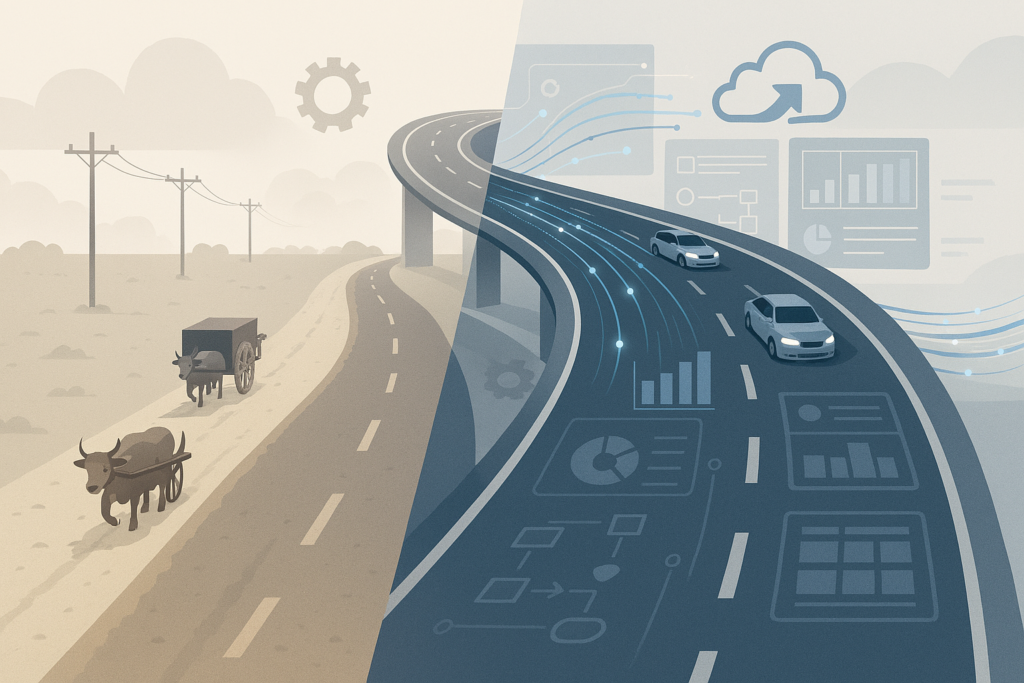
Your ERP Is Like a Highway Built for Bullock Carts
Most businesses don’t notice the problem right away.
The ERP is running. Reports come out on time. Audits are cleared. From the outside, everything looks under control. But inside the organization, there’s a different story playing out every day. Every new requirement feels heavier than it should. A small process change turns into a long discussion. A new workflow takes weeks to approve. Industry-specific needs quietly move outside the system because it’s faster that way.
It feels like driving a modern car on a road built decades ago for bullock carts. The vehicle is capable. The road simply wasn’t meant for today’s speed. That’s where many ERP journeys are quietly stuck as they look toward FY 2026–27.
The Frustration No One Talks About
If you spend time with finance, operations, or supply chain teams long enough, you hear it not loudly, but clearly.
They know what needs to change. They can see inefficiencies. They understand where delays come from. But the system just can’t keep up.
IT teams genuinely want to help, yet every request turns into a project with timelines, dependencies, and trade-offs. Leaders ask for clarity, but answers arrive late and often without context. So, people adapt the only way they know how:
- They build parallel tools
- They fall back on Excel
- They stop expecting ERP to reflect how the business actually runs.
Over time, ERP becomes a system of record, not a system of trust. Gartner has long pointed out that ERP challenges are rarely about failed technology. More often, systems drift away from how businesses actually operate and make decisions.
Why Moving to the Cloud Wasn’t the Finish Line
For many organizations, the move to cloud ERP felt like a turning point. And in some ways, it was. Infrastructure became simpler. Upgrades were smoother. Access improved. But something important didn’t change. A generic ERP, no matter how modern, still struggles to understand industry realities. Forrester has observed that cloud ERP only delivers its promise when businesses can adapt processes quickly without heavy customization or constant reliance on IT. Until then, the cloud is just a new location for old limitations. That’s when many organizations realize the real change hasn’t happened yet.
The Moment ERP Starts to Feel Different
The organizations moving ahead didn’t tear everything down and start over. They changed how ERP evolves. Instead of treating ERP like a locked system that must be protected at all costs, they began treating it like a living structure, solid at the core, flexible where the business needs movement. This is where low-code and no-code platforms, built on cloud ERP, quietly transform everything. It’s like adding service roads, flyovers, and smart exits to an old highway without stopping traffic. Suddenly, small changes don’t need big projects. Business teams can shape workflows themselves. Innovation happens without putting the core system at risk. Gartner describes this shift as the move toward composable ERP systems designed to adapt as the business changes, not months after.
Why Industry Context Changes Everything
There’s a truth many ERP conversations avoid.
Generic ERP treats every business the same. But no two industries think the same way.
- Garment: Styles, seasons, sizes, frequent design changes
- Manufacturing (general): Production runs, yield, waste, planning accuracy
- Paper Manufacturing: Reels, GSM, moisture control, breakage, recovery
- Flexible Packaging: Layers, structures, ink usage, changeovers, scrap control
- Film Manufacturing: Microns, consistency, yield loss, roll utilization
- Folding Carton: Die-lines, sheet optimization, print accuracy, finishing flow
When ERP speaks the industry’s language, teams trust it and use it naturally. It’s not about more features. It’s about the right fit.
Where Samadhan Makes the Difference
As a Microsoft Partner, Samadhan approaches ERP with a long-term view, not as a one-time implementation, but as something that needs to evolve as the business evolves. With deep experience in manufacturing and focused domain understanding of the paper and packaging industry, Samadhan works on ERP foundations built on Microsoft Dynamics 365 Business Central and Dynamics 365 Finance & Operations. By enabling flexibility through low-code and no-code, ERP can adapt as processes change, without constant disruption. For organizations thinking about how to keep ERP aligned with real operations over time, this approach offers a more practical way forward.
The Change Leaders Actually Feel
- The transformation doesn’t arrive with a big announcement. It shows up quietly.
- Earlier, ERP told you what happened last month. Now, it helps explain what’s happening right now and what might happen next.
- Earlier, people worked around the system. Now, the system works the way people think.
What ERP Roadmaps for FY 2026–27 Are Really About
The next ERP roadmap isn’t about replacing systems. It’s about removing friction.
- Cloud sets a stable, scalable base
- Low-code and no-code bring speed and flexibility
- Industry-specific solutions bring real-world relevance
- AI that predicts ahead, automates routine work, flags issues early, and speeds up approvals.
Put together, it’s about:
- Faster deployment
- Lower risk
- No fear of technology becoming outdated
ERP shouldn’t slow the business down or add friction. It should remove obstacles and clear the road ahead for growth.
Need a Demo or Consultation
Do you still have unanswered questions? You can contact our call center.

+91 6287995736
Alternative way to get answer faster.

info@samadhanindia.com
We are always happy to help.