

Microsoft D365 vs SAP B1 in 2026: Why the Platform Gap Is Now Too Wide to Ignore
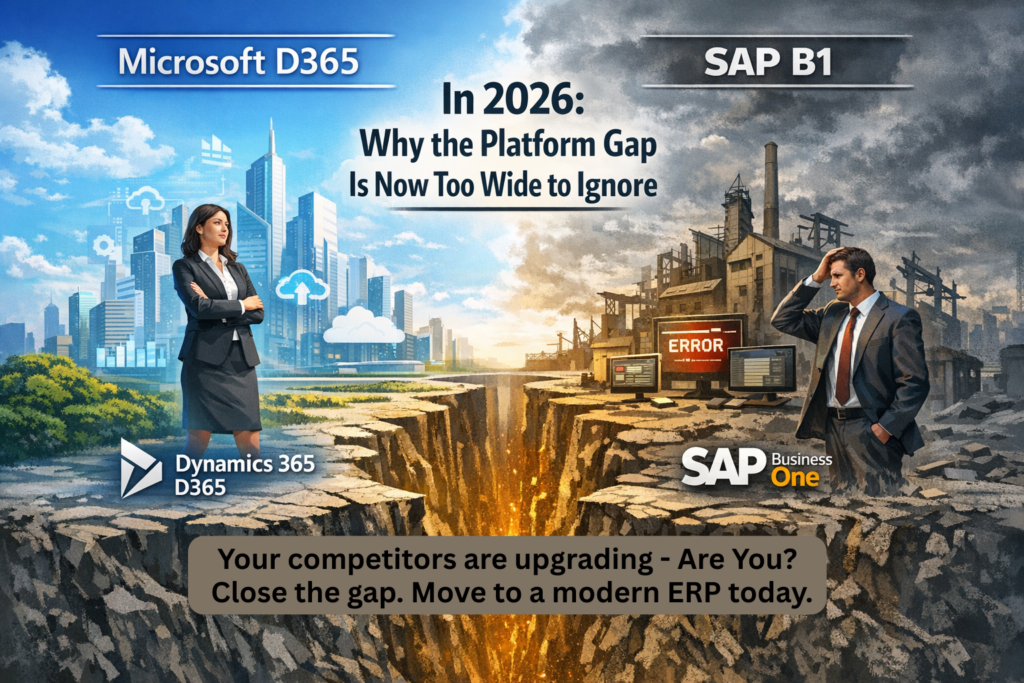
Let’s be honest, if you’re still running SAP Business One in 2026, you’re probably feeling the strain. Not because SAP B1 is a bad product (it served its purpose well), but because the world of ERP has fundamentally shifted, and B1 hasn’t kept up. For businesses actively searching for a SAP Business One alternative for manufacturing, the answer is becoming increasingly clear.
Microsoft Dynamics 365, on the other hand, has quietly transformed from “just another ERP” into something much bigger, a unified, AI-powered business platform. And no, that’s not a marketing buzzword. It’s backed by analyst data, real adoption numbers, and a technology architecture that SAP B1 simply can’t match anymore.
When you look at the SAP B1 vs Dynamics 365 comparison objectively, the gap isn’t narrowing, it’s widening. Let me walk you through what’s actually happening and why it matters for your business.
The Analysts Have Made Their Call
Gartner Magic Quadrant (2025/2026)
Microsoft now sits firmly in the Leader quadrant for Cloud ERP. Gartner specifically highlights its “Ability to Execute” and “Completeness of Vision”. But here’s the part that should concern SAP B1 users, analysts are no longer comparing Dynamics 365 to traditional ERPs. They’re calling it an “Intelligent Orchestration Platform.”
Meanwhile, Gartner has flagged something troubling: SAP’s decision to delist certain legacy products for new customers in 2026. If you’re on B1, this raises uncomfortable questions about long-term roadmap commitment.
IDC MarketScape
Microsoft consistently ranks as a Leader for Medium-Sized Business ERP, with IDC praising its modularity. You can start small, maybe just finance and inventory and layer on AI, automation, and advanced manufacturing capabilities as your business grows. No rip-and-replace required.
SAP B1? It barely features in modern cloud ERP assessments. It’s increasingly grouped with legacy systems, not next-generation platforms.
That’s not opinion. That’s where the industry analysts have placed it.
The Copilot Effect: This Changes Everything
Here’s where things get really interesting.
By Q2 2026, Microsoft reported 15 million paid Copilot seats. That’s not experimental, that’s mainstream adoption. And a huge chunk of those seats are being used inside ERP workflows for things like:
- Automating debt collection follow-ups
- Drafting procurement requests
- Running financial forecasts and variance analysis
- Generating customer service responses
- Optimizing production schedules
Why This Matters More Than You Think
With Dynamics 365, Copilot AI is native. It understands your data across Teams, Outlook, Excel, and your ERP, all at once, without needing separate integrations. This is a critical differentiator in the SAP B1 vs Dynamics 365 debate that most comparison articles miss.
Picture this: You open Teams and type, “Show me overdue invoices from our top 10 customers and draft collection emails.” Copilot pulls live data from your ERP, generates the list, and writes personalized follow-up emails ready to send.
Now try doing that with SAP B1. You’d export to Excel, filter manually, switch to your email client, and compose each message. That’s not a productivity gap, it’s a productivity canyon.
SAP B1’s AI story? It mostly involves third-party plug-ins and clunky “side-car” integrations that don’t share context across your tools. It feels bolted on because, well, it is.
The Numbers Don’t Lie: Cost and Speed
Let’s talk money and time, because that’s ultimately what drives decisions.
Implementation Speed
- Dynamics 365 (Business Central): Typically 3 to 6 months to go live
- SAP B1: 6 to 12+ months, thanks to rigid architecture and heavy customization needs
That’s not a small difference. In a fast-moving market, going live 6 months earlier means capturing revenue, reducing errors, and gaining visibility half a year sooner.
Total Cost of Ownership (5-Year View)
Dynamics 365 consistently shows 40-60% lower TCO compared to SAP B1. Here’s where the savings come from:
- Cloud updates happen automatically no consultant-heavy upgrade projects every few years
- Transparent per-user pricing you know what you’re paying, no surprises
- Power Platform enables in-house customization your team builds workflows, not expensive external consultants
- Azure hosting eliminates server costs no hardware refreshes, no IT overhead
The hidden killer with SAP B1? Version upgrades. Every major update can feel like a mini reimplementation, complete with consultants, testing cycles, and business disruption. In 2026, that’s simply not acceptable.
Platform Architecture: Where the Real Gap Lives
| Feature | Microsoft Dynamics 365 | SAP Business One |
|---|---|---|
| Architecture | Cloud-native on Azure with seamless automatic updates | Hybrid/legacy requiring manual maintenance |
| AI | Native Copilot working across your entire Microsoft ecosystem | Limited; mostly third-party add-ons |
| Customization | Low-code Power Platform, your team can build apps | Hard-coded; needs specialized SAP consultants |
| Reporting | Native Power BI with real-time dashboards and natural language queries | Static Crystal Reports; often requires Excel exports |
| Updates | Monthly, new features just appear | Periodic version jumps that become major projects |
| Ecosystem | Native integration with Teams, Outlook, Excel, Azure | Fragmented third-party connector landscape |
| Scalability | Same platform from 10 users to 100,000 | Data/user caps; outgrowing means migrating to S/4HANA |
| Mobile | Modern, responsive, full-featured | Limited functionality, often read-only |
This is the part that’s hardest to see from a sales demo but makes all the difference once you’re running the system. Let me break it down honestly:
The fundamental difference? Microsoft built a platform. SAP built a product. And in 2026, platforms win.
The Uncomfortable Truth: Spreadsheet Culture
Here’s something every SAP B1 user knows but rarely admits publicly.
Most SAP B1 shops in 2026 are still exporting data to Excel to get the real picture of their business. Production metrics? Excel. Margin analysis? Excel. Inventory reconciliation? You guessed it Excel.
It’s not because the people are bad at their jobs. It’s because B1 wasn’t designed to surface those insights natively. So teams create parallel systems, spreadsheets, manual trackers, WhatsApp groups to fill the gaps.
Dynamics 365 eliminates this entirely. Data flows from the shop floor straight into Power BI dashboards. Real-time. No exports. No reconciliation nightmares. No “which version of this spreadsheet is correct?” conversations.
And this is where Samadhan ERP makes the difference even more dramatic for manufacturers.
Samadhan ERP: Built for Manufacturing, Powered by Microsoft
If you’re in packaging, corrugation, paper, or film manufacturing, the platform advantage isn’t theoretical, it’s the difference between running your business on data versus running it on guesswork. For companies searching for a genuine SAP Business One alternative for manufacturing, Samadhan ERP delivers exactly what B1 can’t. Built on Microsoft Dynamics 365 by Samadhan, it takes the full power of Microsoft’s platform and applies it to the specific, messy, complex world of process manufacturing.
As the leading ERP for packaging industry India, Samadhan doesn’t try to be everything for everyone. Instead, it goes deep where it matters corrugation workflows, packaging costing, and manufacturing intelligence that generic ERPs can’t touch.
Here’s what that looks like in practice:
What Samadhan Does That SAP B1 Simply Can’t (Without Expensive Custom Work)
* Eliminates the Spreadsheet Culture, For Real
Every manufacturing detail, ink consumption, machine running status, waste at each stage, quality parameters gets captured directly in the ERP as it happens. Not in a spreadsheet someone updates at the end of the shift. Not in a WhatsApp message to the plant manager. In the system. In real time.
* Built-in Product Design Interface (PDI)
Before a single sheet rolls off the line, Samadhan’s PDI calculates adhesive consumption, ink usage, substrate requirements, and predicts your margins. SAP B1 users typically do this manually, or worse, discover margin erosion after the job is done.
* Deckle Planning, Waste Accountability & Multi-Layer Costing
These aren’t add-ons or custom developments. They’re built into Samadhan because the team at Samadhan India understands that corrugation and packaging manufacturing has unique workflows that generic ERPs like B1 were never designed to handle.
* Copilot for Manufacturing
Imagine asking your ERP in plain English: “Which production orders are at risk this week?” or “What’s our waste percentage trend for corrugated boxes over the last quarter?” And getting an accurate, instant answer. That’s Copilot + Samadhan ERP working together.
The Strategic Choice for 2026
Let me put it simply:
Choose SAP B1 if you have straightforward, stable business processes, you’re comfortable with on-premise infrastructure, spreadsheets don’t bother you, and you have no plans to grow significantly or leverage AI. It’s a decent accounting-first system for simple operations.
Choose Samadhan ERP on Microsoft Dynamics 365 if you’re in packaging or process manufacturing and you’re tired of spreadsheet workarounds, manual costing, limited visibility, and technology that can’t keep up with your business. You want deckle planning, waste accountability, and multi-layer costing handled by the system, not by your team in Excel at 10 PM.
Why Samadhan?
At Samadhan, we sit at a unique intersection: deep Microsoft platform expertise meets genuine manufacturing DNA.
We’re not generic ERP consultants who’ll spend six months “understanding your industry.” We already understand it. We know what deckle planning looks like at 2 AM when the shift changes. We know why waste accountability matters at the reel level. We know that your CFO needs margin visibility before the job starts, not after it ships.
As a Microsoft Gold Partner specializing in Dynamics 365 Business Central and Finance & Operations, here’s what we bring:
* Manufacturing-first approach: Solutions built for packaging, corrugation, paper, and film, not retrofitted from generic templates
* Platform depth: Dynamics 365, Power Platform, Azure, Power BI, Copilot we leverage the full Microsoft stack
* Rapid deployment: 3-6 months to go live with pre-built industry workflows
* Spreadsheet elimination: We don’t just promise it, we architect it into the solution
* Proven SAP B1 migration: We’ve helped businesses move from B1 to Dynamics with minimal disruption
* Ongoing partnership: Managed services, optimization, and continuous innovation support
* Our mission is straightforward: Give manufacturing businesses the full power of Microsoft’s platform, without the complexity, without the spreadsheets, without the legacy baggage.
Ready to See the Difference?
The data is clear. The analysts agree. And honestly, your team probably already knows the spreadsheets aren’t sustainable.
If you’re running SAP B1 and feeling the limitations or evaluating ERPs for the first time we’d love to have an honest conversation about what’s possible. Whether you’re comparing SAP B1 vs Dynamics 365, questioning your SAP Business One implementation cost, or simply looking for the right ERP for packaging industry India the answer starts with a conversation.
Let’s build something that actually works for manufacturing, without the complexity.
FAQs
Is the Microsoft platform really stronger than SAP B1, or is this just partner bias?
It’s analyst-confirmed. Gartner positions Microsoft as a Cloud ERP Leader while raising roadmap concerns about SAP’s legacy products. The platform architecture (Azure + Dynamics 365 + Power Platform + Copilot) is objectively more integrated and modern than B1’s standalone approach.
We've heard about Copilot, but is it actually useful in manufacturing?
Yes, and it’s measurable. With 15 million paid seats by Q2 2026, Copilot automates production scheduling, demand forecasting, quality trend analysis, and even natural language reporting. It works because it’s grounded in your actual data, not generic models.
Our SAP B1 implementation took forever. How fast can Samadhan ERP go live?
Typically 3-6 months. The difference is that Samadhan’s manufacturing workflows are pre-built, you’re not starting from a blank canvas like you would with B1 customizations.
What does the 5-year cost difference actually look like?
Dynamics 365 typically runs 40-60% lower TCO than SAP B1 over five years. The biggest savings come from automatic cloud updates (no upgrade projects), Power Platform customization (no expensive consultants), and Azure hosting (no server costs).
What if we've already customized SAP B1 heavily?
Samadhan India has proven migration methodologies specifically for SAP B1-to-Dynamics transitions. We map your existing customizations to platform-native capabilities, reducing complexity while preserving your business logic.
What exactly is the Product Design Interface (PDI)?
It’s a built-in tool that calculates material consumption (adhesives, inks, substrates), predicts margins, manages deckle planning, and provides real-time costing all before production begins. With SAP B1, this typically happens in spreadsheets or not at all.
What happens when we outgrow our current setup?
Nothing disruptive. Dynamics 365 scales on Azure from a single plant to global multi-plant operations on the exact same platform. With SAP B1, outgrowing the system means a costly, risky migration to S/4HANA essentially starting over.
How does Samadhan India ensure we actually succeed?
We follow Microsoft’s Success by Design methodology, combined with our manufacturing expertise. That means thorough process reviews, phased implementation, hands-on training, and ongoing managed services. We measure success by your ROI, not just go-live dates.
We're a small packaging company. Is this overkill for us?
Not at all. Dynamics 365’s modular pricing means you start with what you need and grow. IDC specifically recognizes Microsoft as a leader for medium-sized businesses. Unlike B1, you won’t hit a ceiling that forces a painful migration to a different system.
Need a Demo or Consultation
Do you still have unanswered questions? You can contact our call center.

+91 6287995736
Alternative way to get answer faster.

info@samadhanindia.com
We are always happy to help.