


Data Silos Are Quietly Killing Your Paper Manufacturing Business – Here's What Nobody Tells You
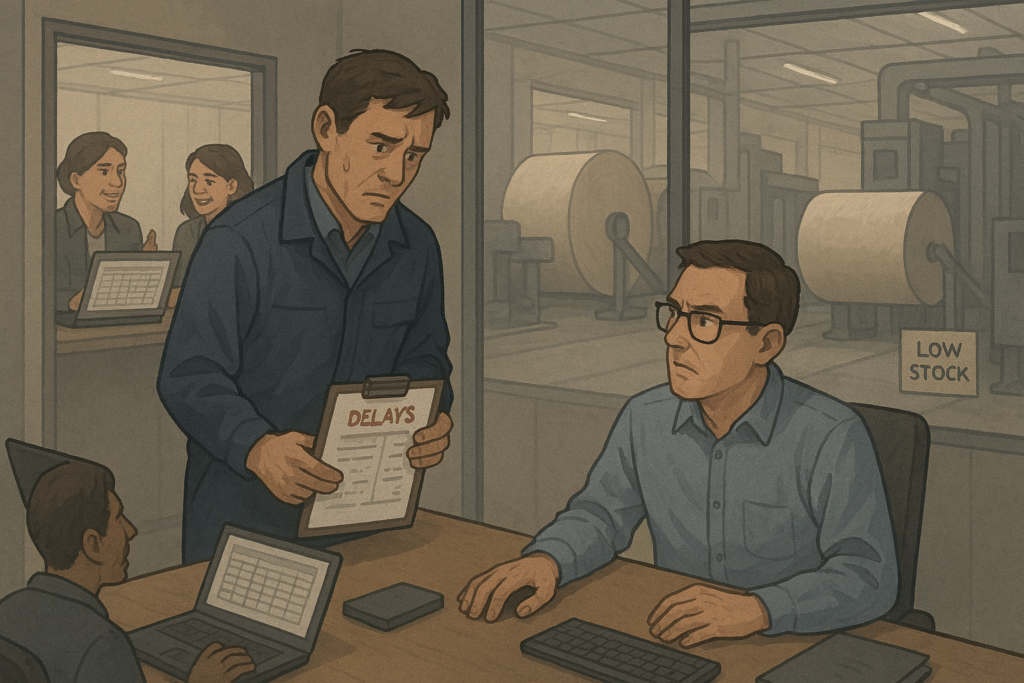
Let me paint a picture you probably know too well.
It’s Monday morning. The production supervisor rushes into your office with bad news. A major customer order is running behind schedule – again. Not because the machines broke down. Not because workers didn’t show up. Simply because nobody knew the raw materials were running low until it was too late.
Meanwhile, your sales team already promised delivery by Friday. They checked their spreadsheet, saw old inventory numbers, and made commitments your plant can’t keep.
Sound familiar?
This is what data silos do to paper manufacturing operations. They create invisible walls between people who should be working together. And honestly? It’s exhausting.
The Hidden Enemy You Can’t See
Here’s the thing about data silos – they don’t announce themselves. They creep in slowly over years. One department starts tracking things their way. Another team builds their own Excel masterpiece. Before you know it, you’ve got five different versions of “the truth” floating around your facility.
In the paper and packaging industry, this fragmentation hits especially hard.
Think about everything that needs to connect. Pulp processing. Converting lines. Quality testing. Warehouse operations. Customer orders. Financial reporting. Each area generates mountains of data every single day.
When these systems don’t talk to each other, chaos follows.
Your quality control team catches a defect, but production doesn’t hear about it for hours. The warehouse shows materials available that were actually used yesterday. Finance reconciles numbers that don’t match what operations reported.
Everyone works harder. Nothing gets better.
The Real Price You’re Paying
Let’s be honest about what disconnected data actually costs your business.
Wasted materials. Without accurate real-time visibility, ordering becomes guesswork. You either stockpile too much inventory (tying up cash) or run short at critical moments (halting production).
Missed deadlines. When sales, production, and shipping operate from different information sources, promises get broken. Customers notice. They remember.
Exhausted teams. Your best people spend hours hunting down information instead of solving actual problems. They email. They call. They walk across the plant asking questions that software should answer instantly.
Poor decisions. Leaders can’t steer the ship when they’re working with yesterday’s numbers – or worse, numbers from last week.
This isn’t just operational inefficiency. It’s competitive disadvantage hiding in plain sight.
Why Traditional Fixes Don’t Work
Many manufacturers try band-aid solutions. They add another spreadsheet. They hire someone just to consolidate reports. They schedule more meetings hoping communication improves.
None of it works long-term.
The real problem isn’t people. It’s systems that were never designed to work together. Legacy software from the 1990s. Departmental tools purchased independently. Homegrown databases that only one person understands.
What paper and packaging operations actually need is a unified foundation. One platform where every department sees the same information, updated instantly, accessible from anywhere.
This is exactly where modern ERP for paper and packaging changes everything.
A Better Way Forward
Enterprise resource planning isn’t new. But the right ERP solution, purpose-built for your industry, eliminates data silos at their source.
Samadhan ERP was designed specifically for paper and packaging manufacturers who are tired of fighting their own systems. Built on Microsoft Dynamics Business Central 365, it brings enterprise-grade capabilities to mid-sized operations without the complexity or cost of legacy solutions.
Let’s talk about what this actually means for your daily reality.
Real Features That Solve Real Problems
Real-time unified dashboards change how you start every morning. Instead of gathering reports from five departments, you see everything on one screen. Production status. Inventory levels. Pending orders. Quality metrics. Financial summaries. All current. All accurate.
No more guessing. No more phone calls asking “what’s the latest number?”
Seamless department integration means information flows automatically. When converting finishes a batch, inventory updates instantly. When sales books an order, production sees it immediately. When quality flags an issue, everyone who needs to know gets notified.
The walls between departments simply disappear.
Advanced inventory and production planning tools help you anticipate problems before they explode. The system knows your lead times, your supplier patterns, your seasonal demand fluctuations. It suggests reorder points. It highlights scheduling conflicts. It keeps you ahead instead of constantly reacting.
Financial management automation eliminates hours of manual reconciliation. Transactions flow from operations into accounting automatically. Reports generate themselves. Month-end closes faster because the numbers were accurate all along.
Cloud accessibility means your data lives securely online, available whenever you need it. Check production from home. Review numbers during customer visits. Approve purchases from your phone. Your business runs whether you’re on the plant floor or across the country.
The Copilot Advantage
Here’s where things get genuinely exciting.
Microsoft Copilot AI is now integrated directly into Business Central 365. This isn’t futuristic fantasy – it’s available today.
Imagine asking your system plain questions. “What orders are at risk this week?” “Which suppliers have been late most often?” “Show me inventory trends for the past quarter.”
Copilot handles routine tasks automatically. It drafts responses. It spots patterns humans might miss. It predicts bottlenecks before they happen based on historical data and current conditions.
For paper manufacturers dealing with complex variables – fiber availability, machine capacity, seasonal demand – this intelligence becomes a genuine competitive weapon.
Purpose-Built for Paper and Packaging
Generic ERP systems force you into workarounds. They don’t understand pulp processing schedules. They can’t handle the unique costing of converting operations. They treat paper manufacturing like any other widget factory.
Samadhan ERP speaks your language.
The platform connects every stage of your operation. From raw material receiving through pulp preparation, converting lines, quality checkpoints, warehouse management, and final customer delivery – one continuous flow of information.
When your sales team checks availability, they see real numbers. When your production planner schedules runs, they see actual capacity. When your CFO reviews margins, they see true costs.
Everyone finally operates from a single source of truth.
The Question Worth Asking
Data silos didn’t appear overnight, and they won’t disappear on their own. Every month you wait, the hidden costs compound. Materials get wasted. Opportunities slip away. Good employees burn out fighting systems instead of doing meaningful work.
But it doesn’t have to stay this way.
Modern ERP for paper and packaging exists precisely because manufacturers like you demanded something better. Something that connects instead of divides. Something that clarifies instead of confuses.
Samadhan ERP, powered by Microsoft Dynamics Business Central 365, delivers exactly that – with premium features, AI-powered intelligence through Copilot, and deep expertise in what paper and packaging operations actually need.
Ready to See the Difference?
Your plant deserves technology that works as hard as your people do. Discover how Samadhan ERP eliminates data silos, connects your entire operation, and transforms information chaos into competitive advantage. Because your business is too important to run on disconnected spreadsheets.
Need a Demo or Consultation
Do you still have unanswered questions? You can contact our call center.

+91 6287995736
Alternative way to get answer faster.

info@samadhanindia.com
We are always happy to help.